Travel insurance is one of those things I buy hoping I never need to use. In fact, when a trip ends and I realise I never had to call the insurer, submit a claim, or spend hours reading policy wording, I consider that a success.
Nothing went wrong.
The flight arrived.
The luggage showed up.
Nobody ended up in a hospital overseas.
That, surely, is the best possible outcome. Yet every time I book travel insurance, I notice the same thing. There is always a more expensive plan. And another one after that. Additional riders. Higher limits. More coverage. More protection against increasingly unlikely scenarios. The message is subtle but clear:
“What if something happens?”
As I have grown older, I have started asking a different question. Not “What is the maximum coverage available?” But rather: “What financial impact would I struggle to absorb on my own?” The answer has changed the way I think about insurance entirely.
Insurance Is a Risk Management Tool, Not an Investment
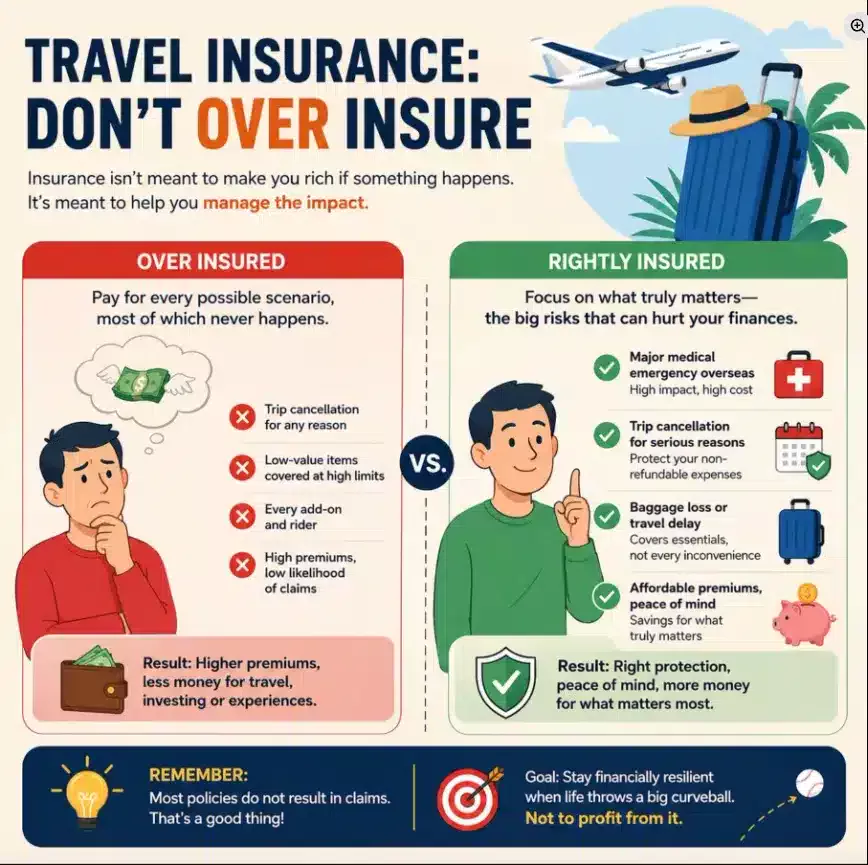
Many people understand this intellectually but behave differently when buying insurance. Some instinctively choose the most comprehensive option available because it feels safer. Others add every available rider because the additional premium appears small relative to the total trip cost. But insurance was never designed to make us richer. It was designed to prevent financial ruin. This distinction matters.
Insurance works best when it transfers risks that would be difficult or impossible for us to absorb ourselves. A major medical emergency overseas, an unexpected evacuation, a serious accident requiring hospitalisation. These are potentially life-changing financial events and precisely the kinds of risks insurance was created for.
A delayed suitcase, on the other hand, is frustrating.
A missed connection is inconvenient.
A cancelled excursion is disappointing.
But most of these situations are temporary setbacks rather than financial disasters.
Something worth thinking about: If the financial impact is manageable, do we really need to insure against it?
The Strange Goal of Insurance
One of the peculiar things about insurance is that success often feels like failure.
You pay premiums year after year.
Nothing happens.
No claims.
No payout.
No visible return.
Some people then conclude that the money was wasted. I see it differently. Imagine returning from twenty overseas trips and never needing to make a claim. Would that really be a bad outcome? Of course not. It would mean twenty successful trips. The purpose of insurance is not to generate a return. The purpose is to provide peace of mind and financial protection if circumstances take a turn for the worse. In many ways, the ideal insurance policy is one you never need to use.
The Trap of Insuring Every Inconvenience
One pattern I have noticed is that many travellers insure against increasingly minor risks.
Airline delay.
Baggage delay.
Missed entertainment tickets.
Rental vehicle excess reduction.
Flight inconvenience compensation.
Travel disruption add-ons.
Some of these may be worthwhile depending on individual circumstances. But collectively, they can significantly increase premiums. And yet many of these events, while irritating, are not financially devastating.
Years ago, my luggage was delayed during a trip. It wasn’t ideal. I bought a few essentials and carried on. The inconvenience lasted a day or two. The trip was not ruined and life went on.
The experience reminded me that not every setback requires insurance. Sometimes a small emergency fund can solve the problem more efficiently than a policy rider. This is where the concept of self-insurance becomes useful.
What Wealthy People Often Understand About Insurance
Over the years, I have observed that financially secure people often approach insurance differently. They do not necessarily buy more insurance. They buy more targeted insurance. They focus on protecting against events that could seriously damage their finances. At the same time, they often self-insure smaller losses. Why? Because they understand that every insurance premium has a cost. The insurer is not operating a charity and the premium must cover expected claims, operating expenses, commissions, and profit.
Over a lifetime, people who insure every possible inconvenience often end up paying far more in premiums than they ever receive in claims. This is not a criticism of insurers. It is simply how the mathematics works. Insurance companies stay in business because, collectively, premiums exceed payouts. That is the entire model. The implication for us is straightforward. We should insure risks that could seriously hurt us financially and absorb the rest ourselves.
The Retirement Perspective
Retirement has made me even more conscious of this principle. When I was younger, I sometimes equated more coverage with better protection. Today, I see things differently. Every dollar spent on unnecessary premiums is a dollar that cannot do something else.
It cannot be invested.
It cannot generate future income.
It cannot fund a meaningful experience with family.
It cannot contribute to the flexibility and freedom that many of us are trying to build.
Does this mean cutting corners on important coverage? Far from it. If I am travelling overseas, I want robust protection against major medical events. Medical costs in some countries can be staggering. A serious illness or accident can easily result in bills running into tens or hundreds of thousands of dollars. That is a risk I do not want to carry alone. But insuring every small inconvenience? That is where I start asking questions.
The Question I Always Ask
Whenever I review an insurance policy now, I ask myself a simple question: “If this happened, could I comfortably absorb the financial impact myself?”
If the answer is yes, I may not need insurance for that risk.
If the answer is no, then insurance deserves serious consideration.
This approach has simplified many financial decisions. It removes emotion from the process and shifts the focus away from fear and toward resilience. Because ultimately, insurance is not about eliminating risk as that is impossible.
Life will always contain uncertainty. Flights will be delayed, plans will change, suitcases will occasionally go missing, unexpected things will happen. The goal is not to create a life where nothing ever goes wrong. The goal is to build a life that can withstand it when something does.
Financial Resilience Matters More Than Perfect Protection
One of the lessons retirement has reinforced for me is that resilience is often more valuable than optimisation.
We do not need perfect portfolios.
We do not need perfect plans.
We do not need perfect insurance coverage.
What we need is enough resilience to recover when life inevitably surprises us.
This applies to investing, it applies to retirement, and it applies to travel. Insurance is an important tool. But it is only one tool. Emergency savings, good judgement, financial discipline, and a healthy margin of safety also matters. Together, these things often provide more protection than simply buying ever-larger insurance policies.
The Real Purpose of Insurance
The longer I think about it, the more I believe the purpose of insurance is remarkably simple. It exists to protect us from outcomes that could materially damage our financial lives. Nothing more, nothing less. This means we should not necessarily seek the cheapest policy. Nor should we automatically seek the most expensive one. Instead, we should seek the policy that protects against the risks we genuinely cannot afford to bear ourselves.
Everything else is a trade-off. After all, every dollar has a job. Some dollars protect us, some dollars grow for the future., and some dollars create memories. The challenge is finding the right balance.
Travel insurance remains something I buy hoping I never use. And if I return home without filing a claim, I won’t feel disappointed. I’ll feel grateful. Because sometimes the best insurance outcome is having no story to tell at all.
Designing a Smarter Retirement
If you’re exploring what a thoughtful retirement could look like, you may find more ideas at www.Retirement-Guru.com or on my Facebook page RetirementGuru.
If this article added value to your thinking, you can Tip Me a Cup of Coffee via Stripe — optional, but appreciated.
For a deeper framework on building a fulfilling retirement across income, health, purpose, and experiences, my ebook Retirement Redesigned. Freedom Redefined. is available through my Gumroad store.
You can also explore retirement-themed gifts and inspiration in my Etsy shop.
Because retirement isn’t just about leaving work.
It’s about designing the life that comes next.